Thank you for the curve of my legs--
I like them.
Also thank you for my ingrown hairs,
even though they’re gross.
Thank you for fingers that have wrinkles on them--
nobody else’s wrinkles,
and I can slap and eat and touch with them.
Thank you for my round eyes
and my achy inner ears,
and the bump on my nose.
Thank you for my hair,
because it’s beautiful--
and even when it’s not,
thank you.
Thank you for the jagged, fisted cramps
that keep me awake once a month,
not just because they remind me
how good notpain is,
but because they are mine,
and only mine,
and this whole body is mine alone:
Mine.
Given to me mine,
mine as a mystery:
body, mind, soul.
And when I’m gasping or retching or bitching
Here I am
in the body, and the mind, and the soul
that was created as me.
~Ruthie

Showing posts with label Beauty. Show all posts
Showing posts with label Beauty. Show all posts
Saturday, April 13, 2013

Friday, January 18, 2013
Mothers to Daughters: "I Am Beautiful"
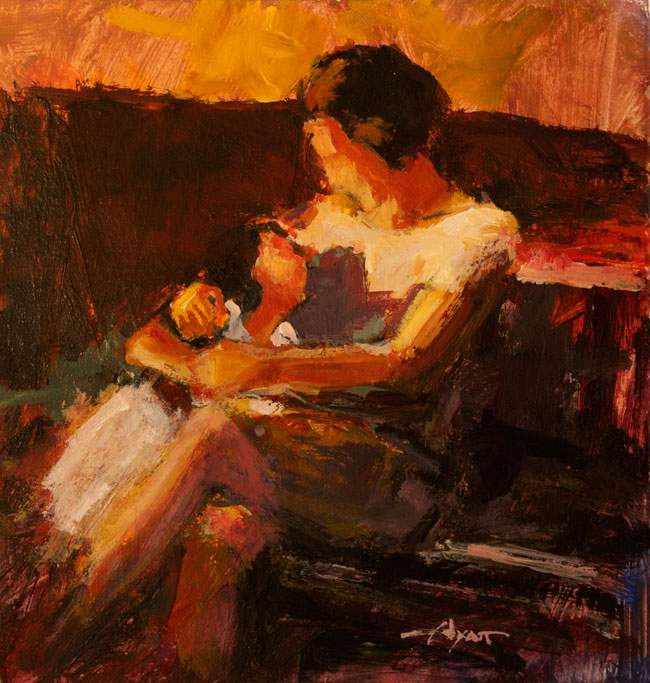
We are a society of all types of women. We are old and we are young, we are short and we are tall, we are big and we are small. Supposedly, we are all beautiful. But as I think more about older women, and the way we live in relation to one another--and particularly as I live my American media and culture infused life--I know, as we all know, that this message is not the one we believe. And our fixation on beauty (or our lack of beauty) often results in the fact that we don’t realize how influential our own actions are. Especially as we relate to each other. So what I want to say is this:
Mothers should tell their daughters that they--the mothers--think they themselves are beautiful.
This might be a shocking idea, especially in the Christian subculture where modesty is a hot topic and false modesty abounds. Plus, beauty itself is a tricky subject, because the question, “What is beauty,” is so slippery. No one denies that most of us have built in triggers that go off when certain physical characteristics appear. However, there’s also no denying that love transforms the beauty of the beloved--and not just in the way of forgetting physical flaws. As love deepens, a lover often begins to truly see their beloved as physically beautiful, even if he or she is not a great beauty. The same goes for familial love. Beauty, I believe, is a combination of body and soul. But back to the issue at hand.
My own mother, like every woman, has her own insecurities. But I have no memory of her discussing her personal appearance as I grew up. I never heard her complain about her weight, or wish for a different hair color, or talk about another woman’s beauty relative to her own. It’s only now that I am an adult myself that she has started sharing her insecurities with me. I am only just beginning to understand how priceless a gift she gave me. Until I reached high school I had a minimal amount of body-related angst. I wanted to look pretty, and I coveted and longed for my friends’ clothing and accessories. But the thought that my body might not be good enough did not occur to me until I was well into puberty.
I’ve never really thanked my mother for this. I’m not even sure she did it intentionally. But I know that it was huge. And I believe that as women, and as Christians, we can take this one step further. We can tell our daughters that they are beautiful, surely. But we can also tell them that we are beautiful.
As with everything, this requires thought and wisdom. A longing for and appreciation of beauty can easily become vanity. This was a timeless moral until the 20th century, when the pop world went crazy and we all became inundated with hundreds of images a day. So something that would have perhaps seemed incredibly selfish a hundred years ago--proclaiming one’s own beauty--has become a matter of importance. Let me explain.
When I was a little girl, I believed that my mother was beautiful. Truly, absolutely beautiful. She was strong and protective and wise, and to me, she was perfect. She was my mother. If she had told me she was not beautiful--if she had complained about her body, and had let me see that her imperfections were unacceptable--I would have been devastated. And then I would have had to ask, “Well, who is beautiful, then?”
When little girls aren’t allowed to believe that their mother is beautiful, the search leads them to the unreal expectations we all face as teenagers and grown women. But if, instead, mothers decided to put aside the disappointment of extra weight and sagging skin, and instead told their daughters, “Yes, it’s true--I am beautiful,” those little girls might have an extra couple of years to soak up the idea that beauty is more than just what they see on a magazine cover. And by the time they entered middle school and high school, maybe they would have at least this one thought in the backs of their minds: “My mother thinks she’s beautiful. And so do I. And if she truly thinks that, maybe beauty isn’t what I’m being told. Maybe it means something much deeper and wider.”
Of course, this presupposes that mothers are discussing beauty with their daughters in all of its fullness--that our beauty is riddled with imperfections and yet we are grateful for the bodies that give breath to our spirits. Perhaps real beauty lies in this idea: that though our bodies are so imperfect, they are our bodies. And because we are not just given bodies to wait out the time until we can fly off and become disembodied souls (thank you Wheaton for helping me understand the heresy of Gnosticism...) we should rejoice in the bodies God has given us. Be they broken, or whole. This doesn’t mean physical beauty is all equal. We have eyes. But physical beauty is much more than our culture leads us to believe. Especially when we look at our bodies through the lens of people who are whole, and not just souls trapped inside flesh. I may not have my neighbor’s hair, but it is my hair. And there is so much beauty in it. These are the kinds of thoughts mothers (and all women) should be examining, and should be unafraid to discuss with their daughters.
But surely, there is room for error here. By telling our daughters that we’re beautiful, they might tend toward believing that physical beauty is more important than it really is. But we all hunger for beauty, even if the topic is taboo. And it’s not taboo...every little girl encounters discussion of beauty, from her first Disney princess movie to her first peek at a magazine in the grocery store aisle. It is better for a mother to claim her own beauty, in a thoughtful and careful way, than for a little girl to encounter it and have no one who is safe to attribute the characteristic to.
Instead of believing that they do not possess beauty and it doesn’t matter, girls should believe that they do possess beauty, and it does matter. Just not in the same way our culture constantly tells us. Beauty as it should be is quiet, and is real, and sometimes carries a few extra pounds around the middle. And daughters need to know that. And another thing: most mothers tell their daughters that they--the daughters--are beautiful. And yet what daughter doesn’t believe her mother is blinded by her motherly love? But if a mother claims her own beauty, and explains how beauty is a mixture of body and soul, healthy and full, perhaps the daughter will begin to believe it when her mother insists that she is beautiful.
None of us thinks we’re beautiful every day. Even the ones who are beautiful by the magazine covers’ standards have bad days. But if we make a point of telling our daughters about true beauty (both the inside and the outside kind) I think we ourselves will have to question if what we say is true or not. There will always be pretty people. But beauty, more often than not, is something we can choose.
~Ruthie
~Ruthie
Tuesday, July 31, 2012
Performance of "Currency"
This is a video of a piece I wrote and performed at my friend Sarah Carleton's fundraiser for International Justice Mission and Restore International. It was a really wonderful event...for more details on that, you can visit this site.
Please
forgive the quality of the video. And because the quality is bad, it's
difficult to tell what I'm doing at the beginning of the piece. I am mimicking
the photographs of women pasted to the wall. The song played at the beginning
is "Grace," by the band U2, and the excerpt of dramatic reading in
the middle is from "The Great Divorce," by CS Lewis.
~Ruthie
Writing and performing a piece about beauty is not easy, if
only because it becomes so personal. In working through the process of writing,
staging, and performing Currency, I had
to become okay with the fact that what the piece says about other people, and
what the piece says about me, are both equally apparent. The only way to have
the audience experience questions I wanted them to ask was through the medium of
my own explorations and insecurities, and my own physical work, presented on
stage. That was very scary.
A few years ago I happened upon a quote by CS Lewis, in the
novel That Hideous Strength. He writes:
“The beauty of the female is the root of joy to the female as well as to the
male, and it is no accident that the goddess of Love is older and stronger than
the god.” I was captivated by this
quote, mostly because I have felt its truth myself. It was from this line of
thought that I ultimately found the pieces to create Currency. I began to wonder: what if we acknowledged our
limitations, and our preferences in the area of beauty? How would it change the
way we act, towards ourselves and toward others, if we were honest about the
glory and the danger of being instruments that can give and receive pleasure,
simply by being embodied?
In a world of extremes, these are dangerous questions. Like
C.S. Lewis’s Ghost, in the excerpt quoted from The Great Divorce, it is so impossible to see ourselves without
comparison. And perhaps the corruption we experience in this world, right down
to the sex trade itself, can be traced back to the impossible task of seeing
ourselves not through eyes that weigh, and compare, but through eyes made holy
by the grace of God—the grace C.S. Lewis’s Spirit is so tenaciously trying to
offer the shabby female Ghost.
In any case, these are questions we have to ask. Questions I
had to ask, and I ask you to continue asking. Even at the risk of discovery.
~Ruthie
Friday, December 16, 2011
The Dangerous, Threatening Search for True Beauty In the World of Australian Ballroom Dancing

I’ve been watching
Baz Luhrmann’s incredible, eyebrow-raising movie Strictly Ballroom since I was a little girl, but it’s only
recently that I have begun to see past the immediate appeal of the movie—the
glitzy dancing, the ugly-duckling-transformation storyline—to what Luhrmann is
trying to say. A thoughtful, innovative director who manages to avoid
pretension (perhaps because he has made only 5 movies over the past 20 years),
Luhrmann created the Red Curtain Trilogy (Strictly Ballroom, Romeo + Juliet and Moulin Rouge) in the ‘90s and my favorite is still the one
I’ve been watching since I was little. His first, his greatest. Strictly
Ballroom.
The movie is set in
the over-the-top world of competitive ballroom dancing in Australia in the
early 1990s, and follows Scott, a dancer who wants to compete by dancing his
own moves—moves that are not “strictly ballroom.” This raises a commotion in
the world of ballroom dancing, and the only woman gutsy enough to dance with
Scott is a novice named Fran. As Fran transforms from an awkward beginner to a
beautiful dancer, Scott has to make choices about whether he wants to take the
risk of dancing his own moves.
As a little girl,
the biggest appeal of the movie was Fran’s transformation and the spectacle of
glittery costumes in bright ballroom lights. But when I watched it a couple
days ago and Hannah and I began discussing it (this is kind of a mixture of
both of our thoughts…I’m just the one putting it into words), I realized that
some of the moments in the movie that have resonated the most with me over the
years are actually quite intentional on the part of Luhrmann and his team. What
Luhrmann is really commenting on is the presence of beauty, the purpose of
beauty, and the interaction between real beauty and the cheap, glitzy
substitute we often put in its place.
It’s very clear that
Fran is the true beauty of the movie—with minimal makeup and normal curly brown
hair she stands in stark contrast to the primped and glittery cast of female
dancers who wear next to nothing. Luhrmann makes the contrast obvious by the
way the other women are filmed, and even for a little girl the movie gave a
clear message that Fran’s true beauty came from her character. But Fran’s story
is only a second application to Luhrmann’s real message, and though both make
commentary on beauty, the more important and more subtle story is Scott’s
search for beauty. His desire to dance his own moves could perhaps be taken as
a metaphor for his need to find freedom from the constraints of society, but I
don’t think that’s what Luhrmann is going for. Scott wants to dance his own
moves because he realizes the cheapness of the world the ballroom dancers have
created—a world full of beauty that decays and stagnates in its own
worthlessness.

The very first scene
of the movie shows off the disparity between Scott’s world and his desires.
Opening on shadowed silhouettes of Scott and his partner, it’s breathtakingly
beautiful to see the outline of a man and woman preparing to step onto the
dance floor, and we hold our breath as we wait for the full glory the
silhouettes promise us. But when they step into the light and march onto the
floor, we are presented with something brash and glittery and fake, and
immediately realize that the shadows at the beginning were much more satisfying
than this thing we’re
watching—punctuated by Luhrmann’s abrasive, too-close shots of the
over-makeuped and lined faces of the dancers and spectators.
That sense of
alienation stays with us through the first part of the movie, though Luhrmann
throws in enough humor and spectacle that we begin to settle into the pace of
the movie and enjoy ourselves. Scott is searching for something; we don’t know
what, but we definitely want him to be able to dance his own moves. Even when
Fran enters the movie and begins to dance with Scott, Lurhmann keeps the shots
just on the edge of something—their
scenes are shot in darkened studios, shadowy and reminiscent of the very first
scene. Maybe, we decide, that shadowy beauty is as good as it gets.
When true beauty
first invades Scott’s world, he doesn’t recognize it, and Lurhmann portrays it
as hostile, scary, and unknown. Scott is walking Fran to the house where her
Spanish immigrant family lives beside the train tracks, and the setting is
striking in its normalcy. The rest of the movie up to this point has been one
bright, fast-paced ride on the bedazzle express, and Luhrmann uses devices to
alienate us along with Scott—the barking of a dog, the frightened glance of
Fran’s grandmother. Luhrmann wants us to be just as surprised as Scott when the
moment comes.
In the next part of
the movie, the focus shifts ever so slightly. We have been constantly barraged
with close-ups, but now the ballroom dancers grow more sinister. The scenes
with Fran begin to sharpen, until Luhrmann presents us with a clear parallel of
the two worlds Scott is wavering between. As Tina Sparkle—Scott’s potential new
partner—dances on stage with her current partner, undulating in the overly
perfect and utterly fake world of ballroom dancers, Scott and Fran dance to the
same music backstage, separated from the glitz only by a curtain. In one of the
most beautiful dance scenes I’ve seen, and definitely my favorite, Luhrmann
films the couple dancing to the Doris Day classic “Perhaps, Perhaps, Perhaps,”
shrouding them in the shadows we’ve come to associate with real beauty.


Luhrmann presents two options to us
When the couple is
spotted and Scott’s family intervenes, we begin to feel claustrophobic. This is
largely because of Luhrmann’s less than subtle filming, and he throws off all
question of who the bad guys are as Fran sits in a chair, surrounded by women
who are shot in bright lights, close-up, at an upward angle that seethes with
hostility. This is the world Scott is struggling to escape. This is beauty,
this is correct. But by now we know, along with Scott, how untrue that is.

Beauty?
When Scott leaves
the competition and follows Fran home, he has no idea anymore what he’s
searching for. Again, we’re struck by the simplicity—the boringness of Fran’s
home. Her family is having a fiesta, and Scott stands beside the garbage cans
and calls to her to come join him. Come dance, he tells her. I want to dance
with you. What is it about Fran that is so alluring to Scott? And then her
father sees them, and his hostility is frightening after the niceness and
glamour of the dancing world. But for the first time in the movie, we realize
that he is sincere. This man, living a normal life, is so starkly in contrast
to the rest of the characters that we’re thrown completely off balance.
When Scott tells him
he and Fran have just been dancing, he asks Scott to show him the Paso Doble.
This is something Scott knows. We breathe a sigh of relief. Scott knows how to
dance. We’re alright. We won’t be harmed by this strange, real, too-honest man.
But when Scott and Fran begin to dance, surrounded by the friends and family of
the immigrants, Fran’s father and the others laugh. We are tempted to laugh
too; somehow, without the bright lights and the skanky costumes, the ballroom
moves are ridiculous and laughable. But we, like Scott, are frustrated. “What’s
so funny??” Scott yells, and the crowd immediately stills.
“Paso Doble?” Fran’s
father asks. He stands and takes off his jacket. “Paso Doble.” And then, before
we’re ready, he dances. He dances a Paso Doble beyond Scott’s skill. Alien,
commanding and magnificent, this man completely wipes away every dance move
that has been done up to this point. When he is finished, he looks Scott in the
eye and once more repeats, “Paso Doble.” Double-step. Out of your experience,
and exactly what you’ve been searching for.
Luhrmann bends all his
skills toward showing us that this is where the true beauty lives. From the
colorful streamers to the tapping of a cigar against a cup, to the beautiful
release as Scott is invited to dance with Fran’s family, we know that we have
found it. Scott’s spinning, arms-raised moment of delight, punctuated by the
bright light of a train passing through the train yard echoes our own
delight—our realization that here, in the dirty world of real life, Scott has
found the beauty he was seeking. And it’s neither in the neon lights of the
ballroom nor the shadows of backstage.
What really makes Strictly
Ballroom great is not just the
fact that Scott finds true beauty, but that Scott does something with it. The
final part of the movie is about Scott learning to dance like Fran’s
father—pushing past the cheap beauty of the ballroom dance world to the harder,
elusive beauty that, as Fran’s grandmother puts it, “Comes from the heart.” And
lest this sound like a cheesy “believe in yourself” kind of movie, that’s not
it at all. The movie isn’t about feeling good about oneself. It’s about not
settling for easy beauty, and about truly searching for the things in life that
are worth it and then using them to inform your art. The world of ballroom is
cheap because it has settled, instead of realizing that true beauty is found
not in escaping and masking the things of this world, but in taking the time to
notice them and expending effort to transform them into something that’s worth
it.
Luhrmann himself has
done just this with his first—and best—film. He takes us on a journey with
Scott, uses the beauty of the real world to showcase the cheapness of our
illusions, and then makes the statement that art, whether it be dancing or
filmmaking, can only truly be beautiful when it is based on things that matter. When the world of ballroom dancing makes one
final last-ditch effort to draw Scott back into its embrace, the colors and the
bright lights and the even more over-the-top face paint is almost nauseating,
compared to the simple beauty we’ve just witnessed at Fran’s fiesta.
Though Scott still has
about thirty minutes of decisions to make, we’ve already made ours. Just as
Luhrmann intended, we are through with strictly ballroom. Not because we’re on
a power trip, or because we’re trying to assert our free will. Because, like
Scott, we’re bored with the mockery of glitz and the façade that everything is
perfect. We want to see real life, and we want to stop and take the time to
notice the headlights on a train and the simple lines of tree branches. We want
to notice these things and then allow them to inform our art and our
interactions with others, just as Fran’s father allows them to inform his Paso
Doble. Just as Scott and Fran allow them to inform their final, fabulous
ballroom dance together.
~Ruthie
Friday, June 24, 2011
Beauty: CS Lewis vs Miss USA

This past Father’s Day my family went to my grandparents’ house. After watching the US Open and America’s Got Talent, the Miss USA Pageant came on and we watched as each state’s representative came out and was judged and eliminated. I sort of felt like I was watching a helicopter crash…it was terrifying, yet I couldn’t look away. But what really interested me was my cousins’ responses. Alethea and Charis are ten and seven, and they were both fascinated by the show. As they were leaving (their dad good-naturedly joking about how he didn’t think they needed to watch any more of the show) Charis kept asking what channel it was on, presumably so she could continue watching when she got home (chances of that = not good…)
Her response to the show reminded me of a quote from That Hideous Strength by CS Lewis, in which he discussed female beauty. He writes:
Did men and women both feel interested in the female body and even, though it sounded ridiculous, in almost the same way? A sentence rose to her memory. "The beauty of the female is the root of joy to the female as well as to the male, and it is no accident that the goddess of Love is older and stronger than the god." (60)
Charis was obviously thrilled by the beautiful women parading across the screen, and I realized that Lewis was right—beauty is just as, if not more, alluring to women as it is to men. A woman takes just as much joy in the female body as the man does, and it is no perversion that leads women to admire the beauty of other women.
But there is definitely perversion of some kind involved in the hunger for beauty that fuels things such as the Miss USA Pageant. Otherwise why would there be such a culture of youth worship, eating disorders, consumerism and all the other stuff that eats away at women? Like Hannah said in her last post, we live in community, and what other people think matters to us. And since being thought beautiful by both men and women is important to girls, there is ample opportunity for perversions of both the standard of beauty and the means to achieving that standard.
But does that mean that competitions like Miss USA are wrong? Should beauty be something that women are allowed to be good or bad at? Beauty—as our culture perceives it—has always been something you have or you don’t, but that is changing. If you aren’t educated, you can become educated. If you aren’t funny, or graceful, or musical, or talented you can work toward becoming more so. And now, if you aren’t beautiful, you can get plastic surgery or implants or botox. Is there a difference?
I guess my real question is whether it’s okay to view beauty as something to be cultivated and judged, like anything else. In a culture of extremes, it’s probably safer to say it’s not okay. We’ve gone beyond viewing beauty as something you have or you don’t, and begun to go to whatever extremes possible to attain it. So does this mean we have to throw out the entire concept of beauty as pleasing? We can’t deny that every one of us has a built-in preference that tends toward beauty.
Maybe the problem is that our perception of beauty has grown too narrow. We have turned into the shade in another work of CS Lewis, The Great Divorce, who runs and hides from the angels sent to escort her to heaven. Like her, our perception of beauty is too narrow to believe that we are capable of giving and taking joy in the way we were created, and we are left either flaunting our bodies, or hiding and saying, like her:
"Can't you understand anything? Do you really suppose I'm going out there among all those people, like this? …How can I go out like this among a lot of people with real solid bodies? …Have everyone staring through me." (59-60)
Maybe there’s nothing wrong with Charis admiring the women onscreen—there is certainly nothing unnatural about it. But there is so much more to be said and thought about when it comes to beauty and the way we treat it, that I feel like I’ve only just scratched the surface. There is so much pain involved in the concept of beauty and how to use and appreciate it that instead of the joy that should come naturally when we’re confronted with beauty, envy, pride and bitterness very often obscure it. And that is definitely not how it should be.
~Ruthie
Subscribe to:
Posts (Atom)