Showing posts with label Motherhood. Show all posts

Friday, January 18, 2013

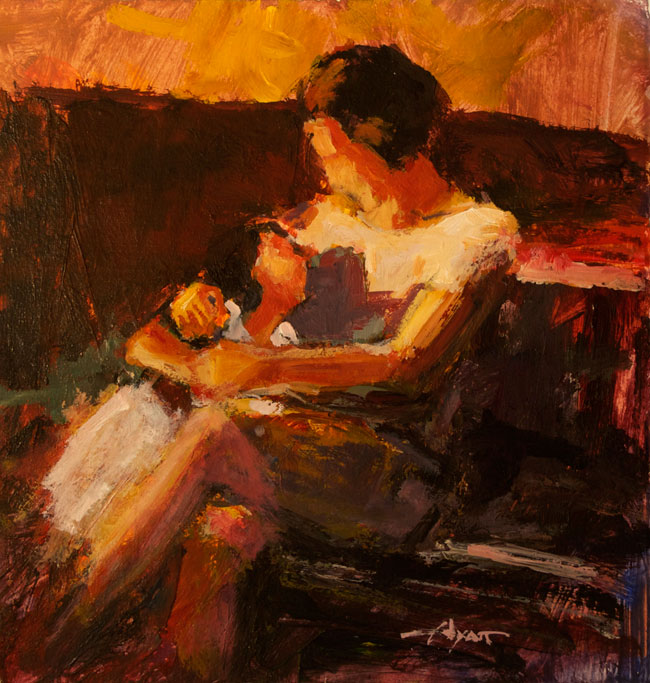
Mothers to Daughters: "I Am Beautiful"


We are a society of all types of women. We are old and we are young, we are short and we are tall, we are big and we are small. Supposedly, we are all beautiful. But as I think more about older women, and the way we live in relation to one another--and particularly as I live my American media and culture infused life--I know, as we all know, that this message is not the one we believe. And our fixation on beauty (or our lack of beauty) often results in the fact that we don’t realize how influential our own actions are. Especially as we relate to each other. So what I want to say is this:

Mothers should tell their daughters that they--the mothers--think they themselves are beautiful. 

This might be a shocking idea, especially in the Christian subculture where modesty is a hot topic and false modesty abounds. Plus, beauty itself is a tricky subject, because the question, “What is beauty,” is so slippery. No one denies that most of us have built in triggers that go off when certain physical characteristics appear. However, there’s also no denying that love transforms the beauty of the beloved--and not just in the way of forgetting physical flaws. As love deepens, a lover often begins to truly see their beloved as physically beautiful, even if he or she is not a great beauty. The same goes for familial love. Beauty, I believe, is a combination of body and soul. But back to the issue at hand.

My own mother, like every woman, has her own insecurities. But I have no memory of her discussing her personal appearance as I grew up. I never heard her complain about her weight, or wish for a different hair color, or talk about another woman’s beauty relative to her own. It’s only now that I am an adult myself that she has started sharing her insecurities with me. I am only just beginning to understand how priceless a gift she gave me. Until I reached high school I had a minimal amount of body-related angst. I wanted to look pretty, and I coveted and longed for my friends’ clothing and accessories. But the thought that my body might not be good enough did not occur to me until I was well into puberty.

I’ve never really thanked my mother for this. I’m not even sure she did it intentionally. But I know that it was huge. And I believe that as women, and as Christians, we can take this one step further. We can tell our daughters that they are beautiful, surely. But we can also tell them that we are beautiful.

As with everything, this requires thought and wisdom. A longing for and appreciation of beauty can easily become vanity. This was a timeless moral until the 20th century, when the pop world went crazy and we all became inundated with hundreds of images a day. So something that would have perhaps seemed incredibly selfish a hundred years ago--proclaiming one’s own beauty--has become a matter of importance. Let me explain.

When I was a little girl, I believed that my mother was beautiful. Truly, absolutely beautiful. She was strong and protective and wise, and to me, she was perfect. She was my mother. If she had told me she was not beautiful--if she had complained about her body, and had let me see that her imperfections were unacceptable--I would have been devastated. And then I would have had to ask, “Well, who is beautiful, then?”

When little girls aren’t allowed to believe that their mother is beautiful, the search leads them to the unreal expectations we all face as teenagers and grown women. But if, instead, mothers decided to put aside the disappointment of extra weight and sagging skin, and instead told their daughters, “Yes, it’s true--I am beautiful,” those little girls might have an extra couple of years to soak up the idea that beauty is more than just what they see on a magazine cover. And by the time they entered middle school and high school, maybe they would have at least this one thought in the backs of their minds: “My mother thinks she’s beautiful. And so do I. And if she truly thinks that, maybe beauty isn’t what I’m being told. Maybe it means something much deeper and wider.”

Of course, this presupposes that mothers are discussing beauty with their daughters in all of its fullness--that our beauty is riddled with imperfections and yet we are grateful for the bodies that give breath to our spirits. Perhaps real beauty lies in this idea: that though our bodies are so imperfect, they are our bodies. And because we are not just given bodies to wait out the time until we can fly off and become disembodied souls (thank you Wheaton for helping me understand the heresy of Gnosticism...) we should rejoice in the bodies God has given us. Be they broken, or whole. This doesn’t mean physical beauty is all equal. We have eyes. But physical beauty is much more than our culture leads us to believe. Especially when we look at our bodies through the lens of people who are whole, and not just souls trapped inside flesh. I may not have my neighbor’s hair, but it is my hair. And there is so much beauty in it. These are the kinds of thoughts mothers (and all women) should be examining, and should be unafraid to discuss with their daughters. 

But surely, there is room for error here. By telling our daughters that we’re beautiful, they might tend toward believing that physical beauty is more important than it really is. But we all hunger for beauty, even if the topic is taboo. And it’s not taboo...every little girl encounters discussion of beauty, from her first Disney princess movie to her first peek at a magazine in the grocery store aisle. It is better for a mother to claim her own beauty, in a thoughtful and careful way, than for a little girl to encounter it and have no one who is safe to attribute the characteristic to. 

Instead of believing that they do not possess beauty and it doesn’t matter, girls should believe that they do possess beauty, and it does matter. Just not in the same way our culture constantly tells us. Beauty as it should be is quiet, and is real, and sometimes carries a few extra pounds around the middle. And daughters need to know that. And another thing: most mothers tell their daughters that they--the daughters--are beautiful. And yet what daughter doesn’t believe her mother is blinded by her motherly love? But if a mother claims her own beauty, and explains how beauty is a mixture of body and soul, healthy and full, perhaps the daughter will begin to believe it when her mother insists that she is beautiful.

None of us thinks we’re beautiful every day. Even the ones who are beautiful by the magazine covers’ standards have bad days. But if we make a point of telling our daughters about true beauty (both the inside and the outside kind) I think we ourselves will have to question if what we say is true or not. There will always be pretty people. But beauty, more often than not, is something we can choose. 

~Ruthie

Friday, July 8, 2011

The Milk Truck Breastfeeding Debate

A woman I know has started this project, and it’s really interesting to me. Some of my female friends who have seen the video love it. Some think it’s really inappropriate. Most of the men who’ve seen it just think it’s weird. Take a look:


My thoughts are a little bit conflicted. I think women should be able to feed their babies when they need to, and I have known women who were told not to feed their babies in public. I think mothers deserve some support when it comes to the huge job of taking care of their children. I think people should be okay with the natural, needed act of breastfeeding a baby. But I also acknowledge that women can be discreet about breastfeeding, and try to cause the least amount of disturbance to people when in public.

I support Jill, assuming that the women she is being an activist for are not obnoxious breast feeders. Breastfeeding is a natural part of life, and we should support the women who do it. And activism is always a little bit ridiculous in its extremeness. :)

What are your thoughts?

~Ruthie

Sunday, May 2, 2010

One Woman's Story of Abortion And Merciless Redemption

I just finished reading Chi An's A Mother's Ordeal and I couldn't recommend it more. During the first few chapters, I was bored with the typical tales of the Cultural Revolution. You can read a slew of other books, all full of horrible, dehumanizing descriptions of China's chaos. But by half way through, Chi An's tale grabbed me in the gut and I found myself waking up to an extremely personal admission of victimization and guilt unmatched by other such memoirs.

Chi An tells her story of growing up, finding a husband, and starting a family, all against the backdrop of China's population control policies. After suffering the cruel delivery of her first child and the forced abortion of her second, Chi An finds herself bitter and self-focused. Willing to do anything for the benefit of her own family and despite deeply suppressed ethical qualms, she takes charge of enforcing the One Child Policy within a local work unit. It is not until she accidentally becomes pregnant for a third time while living in the US with her husband that Chi An wrestles with her deepest longings and deepest guilt. The couple decide to fight to keep this new child alive and in the process are forced to separate all ties with their homeland.

Better than any educated argument or theological belief, Chi An's words from the heart reveal a universal longing for life and the guilt that ensues when it is prematurely ended. Growing up in a world where logical and practical arguments for abortion abound, Chi An continues to be plagued by the human desire to conceive and bare children and when in the end, she becomes complicit in the forced termination of a generation, she and her colleagues suffer from nightmares, recurring sights and sounds, and emotional torment all oriented around the "little hands" that will come after them for justice in the next life. There is no reason Chi An should suffer from guilt considering the positive environment towards abortion in which she came of age, and yet something inside her refuses to accept the actions both committed against her and by her as innocent.

What finally intrigued me most about her account lies within its closing chapters as Chi An retells her first experience with Catholicism. In a beautiful reflection on why people would worship a "dying God," Chi An simply and movingly describes the apologetics of the cross from an outside and Asian perspective. I am doubtful if Chi An took time to catch up on John Stott or Tim Keller's theology before writing down her thoughts on a couple pages (nonetheless predating Keller! ;-), and yet she sums up all of their grand arguments and thoughts through the layman's lens of a Chinese woman who has lived through hell and for the first time ponders what kind of God would be so real that no person could dream him up.

And yet, Chi An falls short of reveling in the grace that lies waiting for her. She senses that there is a vast significant meaning to Christ's death, but she cannot find what it is. Instead, she finds redemption and hope through confession and a new calling in life to set right her imbalanced scales of justice. She declares to have found redemption, but she dares not hope to have found mercy and grace.

The whole of A Mother's Ordeal is well worth reading, but if you never pick it up, at least read below. It will save you the gruesome operating table scenes, but fill you in on one woman's heart full of fear and hope. Fear of a Heavenly justice that she cannot understand and hope in the value of life that she has both betrayed and protected.

"Two hours later, after I had been moved from the recovery room to a regular hospital ward, my baby was brought to me. As Wei Xin looked on, I stretched our my arms to take her from the nurse, suddenly aware of the significance of the moment. It was for the sake of this tiny human being that I had endured so many months of long-distance blackmail and personal torment. I drew my infant daughter close to me, thankful that Wei Xin and I had chosen to defy the authorities, exulting in our triumph.

..."'You are safe now, my little 'illegal' daughter,' I whispered. 'Whatever happens now, no one can ever take you away from me.'

"By the time I returned from the hospital, the first article written by Steve about our case had appeared in Catholic Twin Circle magazine. It closed with an appeal for concerned readers to appeal the INS on our behalf. A surprising number did...

"I was moved to tears of gratitude by these letters, even as I struggled to understand what had motivated their authors to write. Why should these people, strangers all, care what happened to us and our baby? What did they hope to gain from such an act? I had grown up in a culture where only people who knew you well - kinfolk, coworkers, classmates, or close neighbors - exerted themselves on your behalf, and even they expected favors in return. And yet hundreds of Americans from across the country had taken time to petition their government on our behalf. I did not know what to make of such generosity of spirit. 'The American people have good hearts,' Wei Xin and I told Steve wonderingly.

"'Do unto others as you would have them do unto you,' Steve replied. 'Americans would not like to have their government forcing them to abort their unborn children,' he added, 'so naturally they sympathize with you.'

"This 'Golden Rule,' as he told us it was called, had a familiar ring to it. The Analects of Confucius contained a similar precept: 'Do not do unto others what you would not have them do unto you.' But the more I reflect on the two formulations, the more I realized how different they in fact were. Confucius had merely forbidden people to wrong one another, not encouraged them to perform positive acts of charity. Living under such a rule, no wonder so many Americans had written letters on our behalf - and with no expectation of a return.

"The awareness of what others were now doing for me convicted me anew of what I had earlier done to others. Not just once but a thousand times I broken both this new rule and its Confucian variant. I had done to other women what I did not want, and had finally not allowed, to be done to myself. The horror I had hoped to leave behind me in China came back to torment me anew. What good is your regret? I sneered at my reawakened conscience. How does it help the troubled and despairing women, now forever barren, whom you tortured, aborted, and sterilized?

I abandoned myself to the care of my tiny daughter in the weeks following. Holding her in my arms, I could finally let go of the memory of the other little girl or boy who had been taken from me twelve years before. But the joy that my ‘make-up’ baby brought to me was not untempered by sorrow. She was both balm and wound, consolation and accusation, for her very presence seemed to speak to me of all those other children who were absent, who would never be. I had won my struggle to give birth, but how many hundreds of women had lost theirs? I was able to hold my daughter, but how many others would never hold theirs? What right do I have to this child, I thought bitterly, after what I have done?

“One day Wei Xin, looking rather abashed, told me that he wanted to go to church. ‘I know that we were taught by the Party that all religion is superstition, but a lot of my friends at work go, and I would like to find out what it’s all about. Besides,’ he said wryly, ‘if the Communist Party is against it, maybe we should be for it.’

“Wei Xin’s suggestion came out of the blue. There were no Christians in either of our families. My parents had been atheists, while Wei Xin’s had been Buddhists. I had been force-fed Communism, which was virtually the state religion of the People’s Republic, since I was old enough to talk. I was not about to submit myself to some new cult, however pleasant sounding its rules. I didn’t know whether the benevolent heaven of Chinese folklore existed or not, but trying to find out had never seemed to me worth the trouble. I thought Wei Xin foolish for even suggesting that we make the attempt.

“It was by appealing to my concern for Tacheng, who would be entering the sixth grade that fall, that Wei Xin convinced me to go. As far as I could tell, he was receiving no ethical instruction in the public schools at all. Teachers in China placed a heavy emphasis on learning right from wrong, even if it was confounded with Marxist ideology, but all that was missing here. Wei Xin told me that it was in America’s churches, not in her schools, that such things were taught.

“Walking through the doors of Saint Michael’s Church the following Sunday, I had a strong sense of trespassing on forbidden ground. Attending services in China was either discouraged or entirely banned. I had never before been inside any religious edifice, unless one counts the Buddhist temple I had helped a horde of fanatical Red Guards demolish during the Cultural Revolution. The only Christian church I knew of in Shenyang had been converted into a warehouse in the fifties by the government.

“I looked over the hundreds of people present with interest. Mixed in with the Anglos were Mexican Americans, Filipinos, Korean Americans, African Americans, Vietnamese, even a Chinese family or two. No one had ordered these people to come. Like Wei Xin and me, they were all here because they wanted to be. As we sat down I was struck by the realization that this was the first time I had ever taken part in a meeting not organized by the Communist Party for its own purposes. But for what purpose had these people voluntarily gathered here? To practice the Golden Rule? To improce themselves? To socialize? To adore the deity of love?

“I understood almost nothing of what followed. It hadn’t occurred to me that there would be so much chanting and singing, so much standing and kneeling, and so much invoking and summoning in a religious service. I followed as well as I was able, which was hardly at all. I caught only the odd phrase. ‘As it was in the beginning, is now…’ What was in the beginning and is now? ‘Holy, Holy, Holy.’

“I was fascinated by the painful figure on the cross that hung over the altar. Why would anyone worship a dead God, I thought to myself. Chinese god images were always robust and happy – fat, laughing Buddhas without a trace of suffering in their features, or sturdy figures of Guan Gong, a famous general whose body carried no scars from his numerous military victories. Of course they were also easy to dismiss as mere excrescences of human desires – happiness and success embodied in little wooden divinities. But the idea of a dead God was simply absurd. Surely the fact that this man had been killed proved that he wasn’t God at all. Who would want to kowtow before a defeated creature, I thought, unless he was not a mere creature at all but the Creator? But then why had he allowed himself to die? It was almost beyond belief, certainly beyond the human imagination. The wildest dreams of human beings, I was sure, could not have begun to conjure up a dead God. Perhaps there was something to all this after all.

“I remembered the hundreds of women I had forced to have abortions, how they had writhed and screamed and cried. And I remembered my own abortion, and how I had writhed and screamed and cried. If this tortured figure was God, then surely he understood the pain and suffering that I had felt and caused. Was there in his death some larger meaning?

“From the time I was a small girl, I had been eager to help others. It was for this reason that I had become a nurse. At time, I had allowed myself to be twisted by selfishness into acts that I regretted, but my one true desire was to serve, to love. How could I have gotten to be thirty-eight years old and not realized this? That I had hurt and injured others was a failure to love.

“Wei Xin and I enrolled in adult classes, Tacheng in catechism. Months later I made my first confession – and felt at peace with myself for a long time. The little hands that had been clawing at me could no longer reach me in the new place where I lived. My mind laid to rest the little-boy-who-wouldn’t-die to his rest. From now on the only baby’s cries that would wake in the night were those of my newborn daughter.

“I was forgiven, but justice demanded that I do more. I would spend the rest of my life doing good to others – a goal I happily adopted, for it corresponded to my own deepest wishes. I did not know which way the scales of justice would tip when I had completed the course; I would only try to weight them in favor of mercy. In caring for others, I would be atoning for my past crimes. But how could I help women still in China? I resolved to begin by telling my story to Steve, however painful that might be, so that he might write it.”

~Hannah