
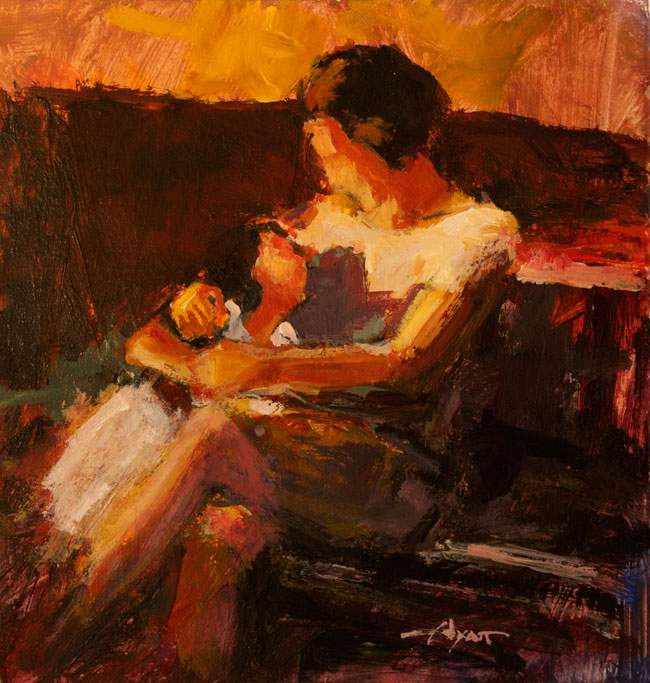
We are a society of all types of women. We are old and we are young, we are short and we are tall, we are big and we are small. Supposedly, we are all beautiful. But as I think more about older women, and the way we live in relation to one another--and particularly as I live my American media and culture infused life--I know, as we all know, that this message is not the one we believe. And our fixation on beauty (or our lack of beauty) often results in the fact that we don’t realize how influential our own actions are. Especially as we relate to each other. So what I want to say is this:
Mothers should tell their daughters that they--the mothers--think they themselves are beautiful.
This might be a shocking idea, especially in the Christian subculture where modesty is a hot topic and false modesty abounds. Plus, beauty itself is a tricky subject, because the question, “What is beauty,” is so slippery. No one denies that most of us have built in triggers that go off when certain physical characteristics appear. However, there’s also no denying that love transforms the beauty of the beloved--and not just in the way of forgetting physical flaws. As love deepens, a lover often begins to truly see their beloved as physically beautiful, even if he or she is not a great beauty. The same goes for familial love. Beauty, I believe, is a combination of body and soul. But back to the issue at hand.
My own mother, like every woman, has her own insecurities. But I have no memory of her discussing her personal appearance as I grew up. I never heard her complain about her weight, or wish for a different hair color, or talk about another woman’s beauty relative to her own. It’s only now that I am an adult myself that she has started sharing her insecurities with me. I am only just beginning to understand how priceless a gift she gave me. Until I reached high school I had a minimal amount of body-related angst. I wanted to look pretty, and I coveted and longed for my friends’ clothing and accessories. But the thought that my body might not be good enough did not occur to me until I was well into puberty.
I’ve never really thanked my mother for this. I’m not even sure she did it intentionally. But I know that it was huge. And I believe that as women, and as Christians, we can take this one step further. We can tell our daughters that they are beautiful, surely. But we can also tell them that we are beautiful.
As with everything, this requires thought and wisdom. A longing for and appreciation of beauty can easily become vanity. This was a timeless moral until the 20th century, when the pop world went crazy and we all became inundated with hundreds of images a day. So something that would have perhaps seemed incredibly selfish a hundred years ago--proclaiming one’s own beauty--has become a matter of importance. Let me explain.
When I was a little girl, I believed that my mother was beautiful. Truly, absolutely beautiful. She was strong and protective and wise, and to me, she was perfect. She was my mother. If she had told me she was not beautiful--if she had complained about her body, and had let me see that her imperfections were unacceptable--I would have been devastated. And then I would have had to ask, “Well, who is beautiful, then?”
When little girls aren’t allowed to believe that their mother is beautiful, the search leads them to the unreal expectations we all face as teenagers and grown women. But if, instead, mothers decided to put aside the disappointment of extra weight and sagging skin, and instead told their daughters, “Yes, it’s true--I am beautiful,” those little girls might have an extra couple of years to soak up the idea that beauty is more than just what they see on a magazine cover. And by the time they entered middle school and high school, maybe they would have at least this one thought in the backs of their minds: “My mother thinks she’s beautiful. And so do I. And if she truly thinks that, maybe beauty isn’t what I’m being told. Maybe it means something much deeper and wider.”
Of course, this presupposes that mothers are discussing beauty with their daughters in all of its fullness--that our beauty is riddled with imperfections and yet we are grateful for the bodies that give breath to our spirits. Perhaps real beauty lies in this idea: that though our bodies are so imperfect, they are our bodies. And because we are not just given bodies to wait out the time until we can fly off and become disembodied souls (thank you Wheaton for helping me understand the heresy of Gnosticism...) we should rejoice in the bodies God has given us. Be they broken, or whole. This doesn’t mean physical beauty is all equal. We have eyes. But physical beauty is much more than our culture leads us to believe. Especially when we look at our bodies through the lens of people who are whole, and not just souls trapped inside flesh. I may not have my neighbor’s hair, but it is my hair. And there is so much beauty in it. These are the kinds of thoughts mothers (and all women) should be examining, and should be unafraid to discuss with their daughters.
But surely, there is room for error here. By telling our daughters that we’re beautiful, they might tend toward believing that physical beauty is more important than it really is. But we all hunger for beauty, even if the topic is taboo. And it’s not taboo...every little girl encounters discussion of beauty, from her first Disney princess movie to her first peek at a magazine in the grocery store aisle. It is better for a mother to claim her own beauty, in a thoughtful and careful way, than for a little girl to encounter it and have no one who is safe to attribute the characteristic to.
Instead of believing that they do not possess beauty and it doesn’t matter, girls should believe that they do possess beauty, and it does matter. Just not in the same way our culture constantly tells us. Beauty as it should be is quiet, and is real, and sometimes carries a few extra pounds around the middle. And daughters need to know that. And another thing: most mothers tell their daughters that they--the daughters--are beautiful. And yet what daughter doesn’t believe her mother is blinded by her motherly love? But if a mother claims her own beauty, and explains how beauty is a mixture of body and soul, healthy and full, perhaps the daughter will begin to believe it when her mother insists that she is beautiful.
None of us thinks we’re beautiful every day. Even the ones who are beautiful by the magazine covers’ standards have bad days. But if we make a point of telling our daughters about true beauty (both the inside and the outside kind) I think we ourselves will have to question if what we say is true or not. There will always be pretty people. But beauty, more often than not, is something we can choose.
~Ruthie
~Ruthie
